
There is a quiet moment, just after sunset, when a home preparing for Chanukah seems to hold its breath. The candles are set in place, the helper candle is ready, and the family gathers close. Then the Chanukah blessings are spoken, a flame is kindled, and the darkness outside feels a little less dark. That small, deliberate act is the heart of the Festival of Lights, and it is repeated, with one more candle each night, for eight nights.
Chanukah and Hanukkah are alternate spellings of the same festival, so you will see both forms in books, cards and online guides. In this guide we use Chanukah for the main keyword, while also covering the familiar Hanukkah blessings wording that many families search for. Whether you are lighting the menorah for the first time, teaching children the tradition, or sending warm words to someone far away, this guide brings together the traditional prayers, their meanings, clear lighting instructions, greetings for each night, and messages you can share.
The Chanukah blessings are short, but they carry a great deal. They bless the act of lighting, they remember miracles from long ago, and, on the first night, they give thanks simply for reaching this season. Understanding what each blessing means makes the lighting feel less like a routine and more like a moment you truly enter into. It also helps when guests who are new to the tradition are present, because you can explain, in plain language, what is happening and why it matters.
What Are Chanukah Blessings?
Chanukah blessings are the prayers recited immediately before the menorah candles are lit. They are said while holding the lit shamash, the helper candle, and they come before any candle is kindled. On the first night, three blessings are recited. On each of the other seven nights, only the first two are recited. That pattern is one of the first things to learn, and it answers the most common question newcomers ask.
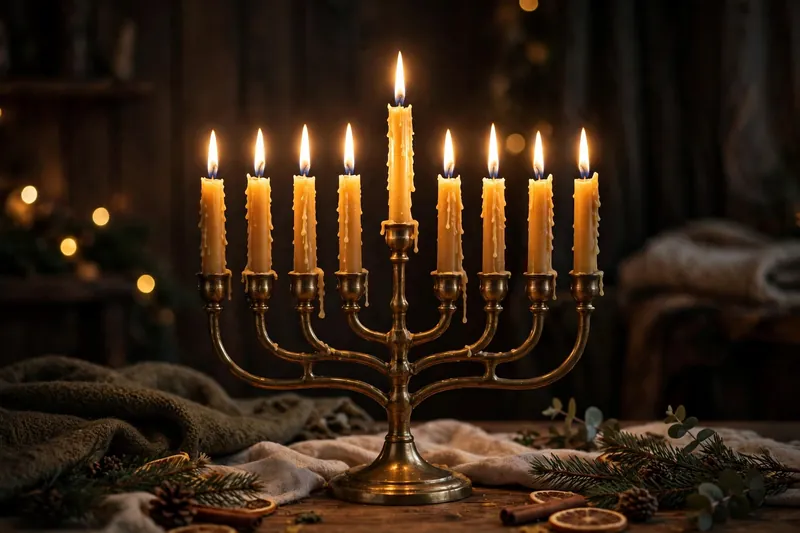
The special nine-branched candelabrum used at Chanukah is called a hanukkiah. It should not be confused with the seven-branched menorah of the ancient Temple. The hanukkiah holds eight candles, one for each night, plus the shamash, which stands apart, often a little higher than the rest. The shamash is not counted among the eight; its job is to light the others, and then it returns to its own place.
These menorah candle blessings are recited in Hebrew in most homes, often followed by an English translation so that everyone present can follow the meaning. Some families sing them to a familiar melody, while others speak them slowly and simply. There is no need for perfection. The tradition values intention, presence and the act of gathering far more than flawless pronunciation, and children who hear the blessings year after year usually learn them naturally by listening.
The Three Traditional Candle Blessings Explained
The first blessing blesses the act of lighting itself. It names the commandment, or mitzvah, that the lighting fulfils, and it turns an ordinary flame into a sacred act. In transliteration it begins: Baruch atah, Adonai Eloheinu, Melech haolam, asher kid’shanu b’mitzvotav v’tzivanu l’hadlik ner shel Chanukah. In English: “Blessed are You, Lord our God, King of the universe, who has sanctified us with His commandments and commanded us to light the Chanukah lights.” This blessing is said every night, and it is the blessing most people learn first.
The second blessing remembers the miracles. It says, in transliteration: Baruch atah, Adonai Eloheinu, Melech haolam, she-asah nisim la’avoteinu bayamim hahem bazman hazeh. In English: “Blessed are You, Lord our God, King of the universe, who performed wondrous deeds for our ancestors in those days, at this season.” The phrase “in those days, at this season” is the heart of this blessing. It joins tonight’s flame to an ancient story, as if the same season has come round again and the same hope is being lit.
The third blessing is the Shehecheyanu, and it is said on the first night only. In transliteration: Baruch atah, Adonai Eloheinu, Melech haolam, shehecheyanu v’kiy’manu v’higiyanu lazman hazeh. In English: “Blessed are You, Lord our God, King of the universe, who has given us life, sustained us, and enabled us to reach this season.” If you are lighting for the first time this Chanukah on a later night, for example because you were travelling on the first night, you say the Shehecheyanu the first time you light. For a fuller first-night guide, see our guide to the first night of Hanukkah blessings, which sets out the three prayers in Hebrew, transliteration and English.
After the candles are lit, it is customary to recite Hanerot Halalu, “We kindle these lights”, which explains that the lights are kindled for the miracles and wonders, and that they are holy and set apart. Many families then sing Maoz Tzur, known in English as “Rock of Ages”. These come after the lighting rather than before, as a way of sitting with the light you have just made, instead of rushing on to the next part of the evening.
How to Light the Menorah, Night by Night
Lighting the menorah follows a simple pattern that is easy to remember once you have done it once. Candles are placed from right to left, but they are lit from left to right, so the newest candle is always lit first. On the first night, one candle sits in the far-right cup. On the second night, a second candle is added to its left, and that new candle is lit first, followed by the first night’s candle. The same pattern continues until, on the eighth night, all eight candles are burning.
Begin by placing the candles for that night, then light the shamash and hold it while you recite the blessings: two blessings on most nights, three on the first night. Use the shamash to light the candles, starting with the newest, then return the shamash to its holder. Let the candles burn for at least half an hour after nightfall, and do not use their light for ordinary tasks such as reading or working. The glow itself is the point, and tradition asks for a pause in which you simply watch, talk and be together.
Timing matters. The menorah is normally lit after nightfall, when it is fully dark, so that the lights can be seen and can publicise the miracle. The one exception is Friday evening, when the menorah is lit before the Shabbat candles, while it is still light outside, because kindling fire is not permitted once Shabbat has begun. If you are unsure about local times or customs, a reputable guide such as the Chanukah guide at Chabad.org sets out the calendar, the blessings and the practical details in one place.
The Story of Chanukah in Brief
Chanukah commemorates the rededication of the Second Temple in Jerusalem in 164 BCE, after the Maccabees reclaimed it from the Seleucid king Antiochus IV Epiphanes, who had desecrated the Temple and outlawed Jewish practice. Led by Mattathias and his son Judah Maccabee, the Maccabees fought to defend their religious freedom in a struggle that lasted several years. When the Temple was cleansed, only one small sealed jar of pure oil could be found, enough to keep the Temple lamp burning for a single day.
According to the account in the Babylonian Talmud, that small jar burned for eight days, until new oil could be prepared. That is why Chanukah lasts for eight nights, and why it is called the Festival of Lights. The festival begins on the 25th day of Kislev in the Hebrew calendar, which usually falls in late November or December. For the historical background, including the Maccabean victory and the miracle of the oil, see the Britannica guide to Hanukkah, which traces the festival from its origins to its modern observance.
The story is not only about oil. It is about a small community holding on to its faith and customs under pressure, and about a light that lasted far longer than anyone expected. That is why the blessings speak of miracles “in those days, at this season”: the festival asks each generation to notice where a small light is still burning in its own time. Telling the story on the first night, especially to children, is one of the most lasting traditions of the festival, because children remember a story long after they have forgotten a list of rules.
Chanukah Blessings and Greetings for Each Night
Each night of Chanukah has its own feeling. The first night is about beginning, the middle nights about growth, and the eighth night about fullness. Happy Chanukah wishes can reflect that journey, becoming warmer and fuller as the candles multiply. A short greeting is often better than a long one, because it can be sent as a text, written in a card, or spoken aloud at the table without losing its warmth.
On the first night, you might say: “Chag Sameach! May the first candle of Chanukah fill your home with light, warmth and every blessing.” On the second night: “Two flames tonight, and twice the hope. Happy Chanukah to you and your family.” By the middle nights, a message such as “May your blessings multiply with every candle, just as the light grows brighter each night” fits the moment beautifully. These greetings work because they follow the festival itself: they grow, night by night, as the hanukkiah fills.
On the later nights, try: “As the candles gather, may your home gather joy, peace and laughter too.” On the eighth night: “Eight candles, one bright light. Happy Chanukah! May the fullness of this festival stay with you all year.” If someone you love is facing a hard season, a gentler message may be right: “May the light of Chanukah reach you where you are, and may hope, like these flames, keep burning.” Words like these carry the same spirit as our collection of blessings of hope, which many readers turn to when they need encouragement for difficult days.
Messages to Share with Family and Friends
Not everyone can be at the candle-lighting in person, and Chanukah is a wonderful time to send love in words. The best messages are warm, respectful and rooted in the spirit of the festival, rather than grand or formal. They work for cards, texts, emails and social posts, and they suit family, friends, neighbours and colleagues who celebrate the festival.
Here are messages you can copy, adapt or use as a starting point for your own words:
- Happy Chanukah! May your home be filled with light, laughter and the warmth of the people you love most.
- Chag Sameach! Wishing you eight nights of miracles, big and small, and a year lit by hope.
- May the miracle of the oil remind you that what you have is always enough. Happy Chanukah!
- Sending you Chanukah blessings: health, joy and eight nights of togetherness.
- As you light the candles tonight, may your heart be filled with peace and your home with song.
- Happy Chanukah to you and yours. May every flame bring a new blessing to your door.
- One small candle can hold back a great deal of darkness. May yours shine brightly all eight nights.
- From our family to yours: blessed Chanukah. May the Festival of Lights renew your faith and your joy.
- May the shamash guide each flame, and may every blessing of Chanukah find its way to you.
- Wishing you latkes, laughter, light and love. Chag Sameach!
When you write your own message, name something specific if you can: a shared memory, or a hope for the year ahead. A short, sincere message sent on the right night is worth far more than a long message sent late.
Family Traditions That Make the Festival Shine
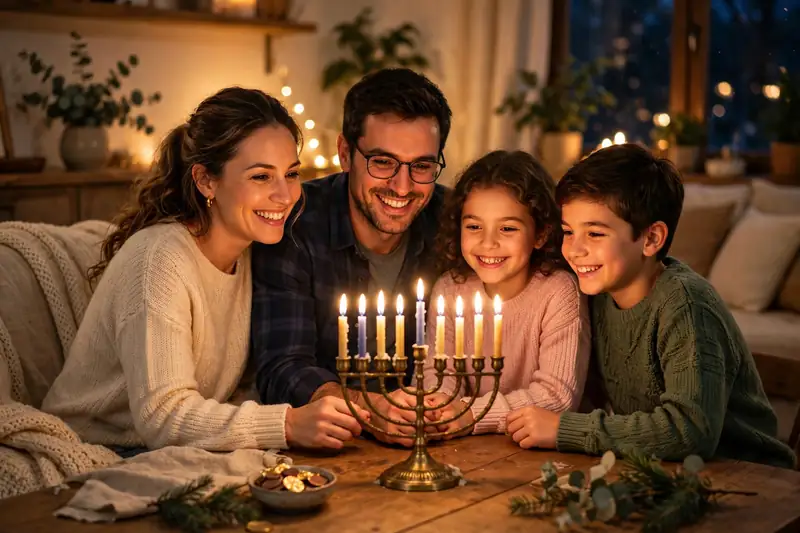
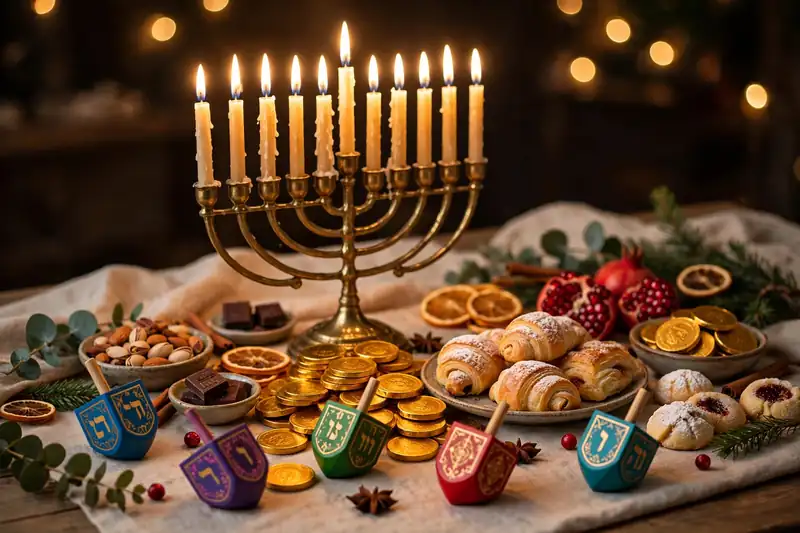
The blessings and the lighting are the heart of Chanukah, but family traditions give the festival its colour and its memories. Eating foods fried in oil honours the miracle of the oil. Potato latkes with sour cream or apple sauce are the classic choice in many Ashkenazi homes, while sufganiyot, jam-filled doughnuts, are beloved everywhere, especially in Israel. Cooking together, with children grating potatoes or filling doughnuts, turns the food into part of the celebration rather than just a meal.
Playing dreidel is another beloved tradition. The four-sided spinning top is marked with the Hebrew letters nun, gimel, he and shin, standing for “nes gadol haya sham”, “a great miracle happened there”. Players traditionally play with gelt, chocolate coins wrapped in gold foil, and the game is simple enough for young children while still being fun for adults. Giving small gifts or gelt, telling the story of Judah Maccabee, and singing together, from Maoz Tzur to I Have a Little Dreidel, all belong to the same joyful pattern.
Some families add their own customs, such as a different person lighting each night, or pausing after lighting to share one thing they are grateful for.
Tips for a Meaningful Chanukah
A meaningful Chanukah rarely happens by accident. It grows from small, thoughtful choices made before the first candle is lit, and from the habit of slowing down once the flames are burning. These tips will help the festival shine, whether you are hosting a large family gathering or lighting quietly at home.
- Prepare the blessings in advance. Print the Hebrew, transliteration and English texts so every guest can follow along. Guests who are new to the tradition will feel included rather than lost.
- Buy enough candles. You need 44 candles over eight nights, plus a shamash each night, so buy a full box early and keep spares. Running out mid-week is a classic mishap.
- Light at a calm hour. Protect the half hour after lighting. Put phones away, sit together, and let the candles do their quiet work.
- Give each night a theme. Gratitude one night, courage the next, hope the next. A theme gives conversation a starting point and helps children remember each night.
- Count your blessings, night by night. After lighting, let each person name one blessing, so the light grows alongside gratitude. Our guide to count your blessings meaning explains why naming blessings one by one is such a powerful daily habit.
- Invite someone in. A neighbour, a friend far from family, or a guest who has never seen a menorah lit will often treasure the invitation far more than you expect.
- Keep the songs simple. One familiar song, sung together, matters more than a long programme. Even off-key singing counts.
- Send one message a night. A short greeting to a different person each night spreads the festival far beyond your own table.
Frequently Asked Questions About Chanukah Blessings
How many Chanukah blessings are there?
Three blessings are recited on the first night, and two blessings on each of the other seven nights, all said before the candles are lit.
What is the Shehecheyanu blessing?
The Shehecheyanu is the blessing of arrival, thanking God for giving us life, sustaining us and bringing us to this season, and it is said on the first night only.
When do you light the Chanukah candles?
The candles are normally lit after nightfall, except on Friday evening, when they are lit before the Shabbat candles while it is still light outside.
Do you place the candles from right to left or left to right?
Candles are placed from right to left, but lit from left to right, so the newest candle is always lit first.
What is the shamash?
The shamash is the helper candle, set apart from the eight nightly candles, which is lit first and used to kindle all the others.
What does Chag Sameach mean?
Chag Sameach means “happy holiday” in Hebrew, and it is a warm, general greeting for Chanukah and other Jewish festivals.
Can I say the Chanukah blessings in English?
Yes, many families say the blessings in Hebrew and then read the English translation, so that everyone present understands their meaning.
What if I miss the first night?
If you light for the first time on a later night, say the Shehecheyanu that first time you light, and then continue with two blessings on the remaining nights.
Carry the Light of Chanukah With You
Chanukah blessings are small words with a large reach. They bless a flame, remember a miracle, and give thanks for the simple fact of being here, together, at this season. They are spoken in a few moments, but they shape eight nights, and often a whole year of memories. The light grows night by night, from one candle to eight, and so, if we let it, does our gratitude, our courage and our hope.
As you light your menorah this year, take a moment after the blessings to look at the flames and to notice who is beside you. Send a message to someone who cannot be there. Share a blessing, a song, a latke and a story. The miracle of Chanukah was never only about oil lasting longer than expected; it was about light lasting longer than darkness. May your Chanukah blessings do the same, in your home and in every home you touch with them. Chag Sameach!

DailyWishHub is your everyday source for wishes, greetings, and special occasion messages, managed by Lucas Bennett, an SEO content writer with 2 years of experience, crafting reader-friendly content that makes every celebration more memorable.
1 thought on “Chanukah Blessings: Candle Prayers, Greetings & Wishes”